Introduction to my project

with No Comments

Hello! My name is Tamara and I am a senior Computer Science Major at Earlham College and this is my capstone project. I am interested in applying machine learning and other computational techniques for better understanding of social issues. Here is the abstract of my capstone project proposal.

Unmanned Aerial Vehicles (UAVs) have only recently been applied
in the detection of clandestine graves. With the growing technical
abilities of UAVs, more opportunities are available in methods
for recording data. This opened many doors for detecting hidden
graves because now many different sensing devices can be used
in remote areas that were inaccessible to humans. This study will
compare the use of hyperspectral and RGB images taken by drones
to detect hidden graves. It is aiming to compare how accurately
the graves can be detected post-image processing using the same
technique. The primary motivation is to help future researchers
more easily decide which data collection technique they should use.
The processing technique used on both data sets is a model with
an edge detection algorithm.
Introduction

with No Comments

Hello! My name is Tamara and I am a senior Computer Science Major at Earlham College and this is my capstone project. I am interested in applying machine learning and other computational techniques for better understanding of social issues. Here is the abstract of my capstone project proposal.

Unmanned Aerial Vehicles (UAVs) have only recently been applied
in the detection of clandestine graves. With the growing technical
abilities of UAVs, more opportunities are available in methods
for recording data. This opened many doors for detecting hidden
graves because now many different sensing devices can be used
in remote areas that were inaccessible to humans. This study will
compare the use of hyperspectral and RGB images taken by drones
to detect hidden graves. It is aiming to compare how accurately
the graves can be detected post-image processing using the same
technique. The primary motivation is to help future researchers
more easily decide which data collection technique they should use.
The processing technique used on both data sets is a model with
an edge detection algorithm.

Project intro

with No Comments

My name is Khoa, and I am a senior, double-major in Quantitative Economics and Data Science. My tentative project focuses on the application of Machine Learning to study the physical-chemical properties of different molecule structures, which has been proven useful in many fields like drug discovery, materials science, biology, etc.

Project Intro

with No Comments

Hi everyone, I am Devin. I’m a Data Science major and a senior.

For my project, I am creating a win probability model for the National Hockey League. Hockey has been one of my favorite sports since I was a little kid and applying statistical concepts to one of my favorite sports excites me. Ultimately, I would like to compare the model that I build to other win probabilities for the NHL. The model accuracy would be assessed by how well it can predict which team wins the game.

Project Introduction

with No Comments

I am Tra-Vaughn James, a Computer Science major, and Junior:

Today, Bioinformatics is an evolving field, in which computing resources have become more powerful, readily available and workflows have increased in complexity. New workflow management tools (WMT) attempt to develop software that fully harnesses this computational power, creating intuitive implementations utilizing machine learning techniques. This streamlines the design of complex workflows. However, overarching problems still remain that newer workflow management tools do not fully address: they are too specific to particular use cases, and they present a great learning curve for users unfamiliar with computing environments. Many implementations require one to spend copious amounts of time understanding the tool and adjusting already existing frameworks to ones needs, creating frustration and inefficiency. This problem is experienced by both novice and experienced bioinformaticians alike. Using OpenWDL, a Workflow Description Language, as the basis, I seek to develop an open in use workflow management tool coupled with a GUI interface. As OpenWDL is a widely known WMT, its familiarity will aid in my implementations usability. Additionally, the GUI interface will present a more welcoming environment than that of a command line interface in which many WMT’s often employ. To assess the effectiveness of my implementation, I will then assess it to other WMT’s, comparing its usability and openness to other bioinformatic pipeline managers such as SnakeMake and NextFlow.


Research on Low-Cost Portable Air-Quality Sensor System

with No Comments

Abstract

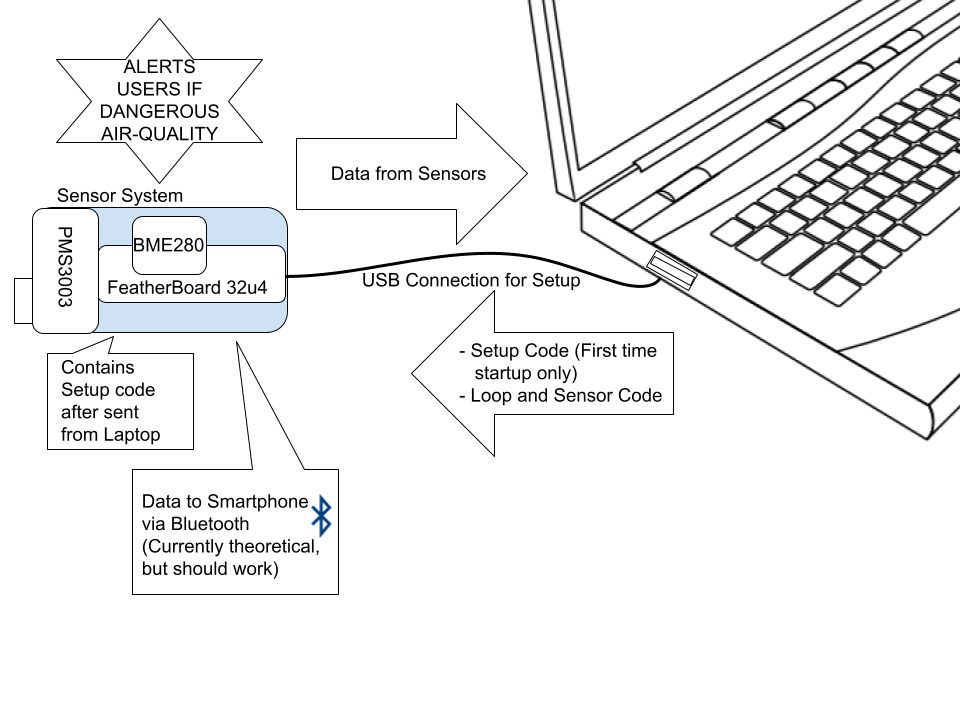
A low-cost portable sensor system allows users to monitor the different components of the air quality around them. There is a need for a sensor system like this because of the millions of deaths and diseases that occur every year due to air pollution worldwide. My planned contribution is for the prototype sensor system I design and build to be as DIY (do it yourself) and low-cost as possible while still being usable in a theoretical online network for large-scale pollution mapping in real time. I will program the sensors together and investigate the calibration of the sensors because they can fall out of calibration after extended periods of time. I will evaluate the results of my experiment of building and using the sensor system by: the robustness of the system indoors and outdoors, analyzing the repeatability of the experiment, accessing how the system could further be improved for ease-of-access to users financially, testing system portability, and the practicality of the theoretical network that could be made with multiple sensor-systems.

Software Diagram

Link To GitLab Project

https://code.cs.earlham.edu/jccosta181/sensor-system-research

Link To Software Demonstration Video