Cube Dash – A super simple Unity game
ABSTRACT
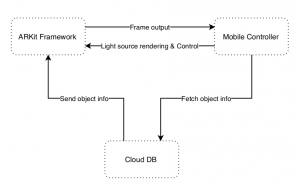
As for today, augmented reality technologies are shifting towards small devices with a focus on user interaction. As more techniques in rendering AR objects are developed, more computing powers are needed to keep up. Mobile AR technology has all functions built in, in addition to GPS and compass for realistic AR rendering technology. However, mobile devices lack storage and the raw power for 3D rendering of complex objects. The paper discusses the possibility of integrating cloud to fix these problems, and conclude that using cloud for performance is difficult while using cloud for storage is possible. Results show that performance drop when utilizing cloud storage for 3D objects are minimal. As for now, cloud fetched objects are rendered without textures, leading to a reduce in realism compared to local fetched objects. Thus, the next step of the pro ject is implementing textures fetch from cloud DB on top of the 3D object file fetch.
Abstract
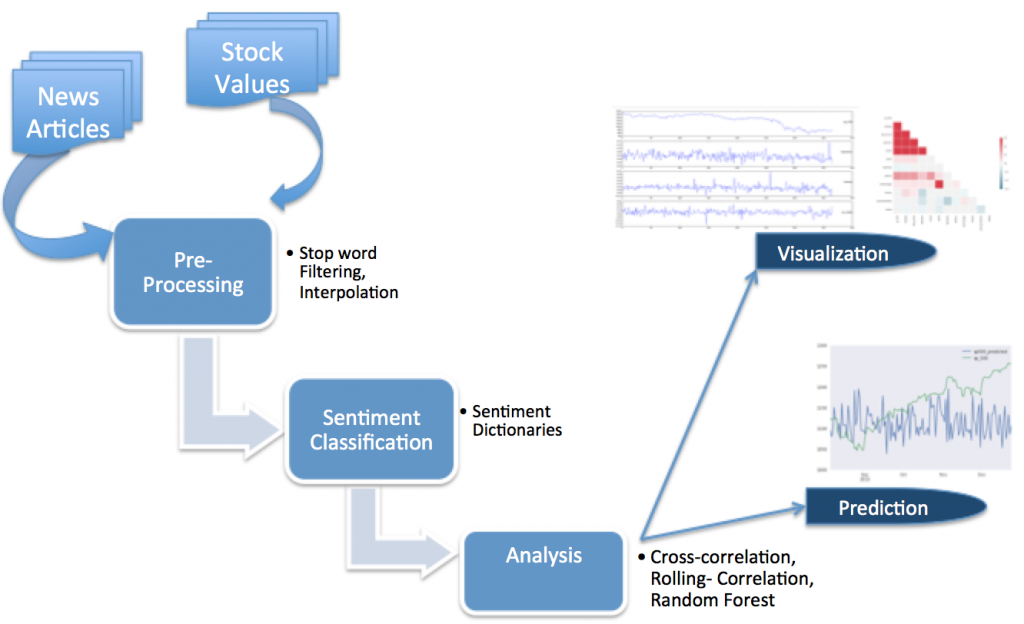
For decades people have tried to predict the stock markets. Some have used historical price trends to predict future changes, while others rely on their gut feeling to make predictions. The prices of stocks reflect the overall confidence the market has on the stocks. The level of this confidence, according to the behavioral economics, is a collective of society’s emotions towards a particular stock, which to some extent influences their decision-making. However, is there a way to know the collective mood of society towards a stock? Can this mood be extracted from newspaper articles and magazines? To address this question, I turn to the field of Natural Language Processing. With the help of various sentiment dictionaries, I ran various types of sentiment analysis over 1.7million newspaper articles published in The Guardian between 2000 and 2016. I then chart the changing sentiments over a time period against the various stock market indices to see whether or not news sentiment is predictive of economic indicators such as stock prices.
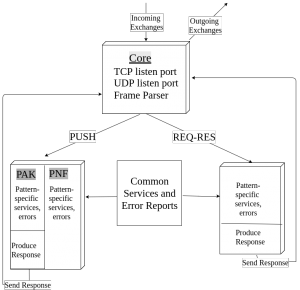
Software Architecture :
Links:
ABSTRACT
There has been a lot of attempts in building predictive models that
can correctly predict the stock price. However, most of these models
only focus on different in-market factors such as the prices of other
similar stocks. This paper discusses the efficiency/accuracy
of three different neural network models (feedforward, recurrent,
and convolutional) in predicting stock prices based on external
dependencies such as oil price, weather indexes, etc.
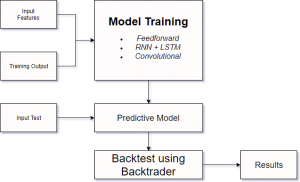
Software architecture
Links:

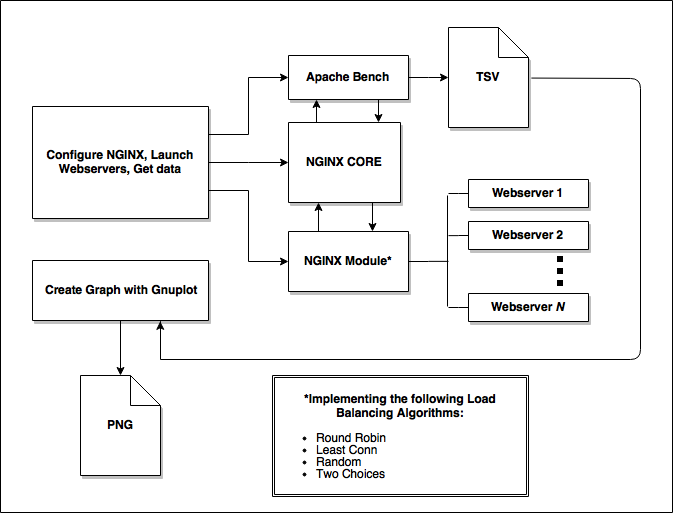
Load balancing remains an important area of study in computer science largely due to the increasing demand on data centers and webservers. However, it is rare to see improvements in load balancing algorithms implemented outside of expensive specialized hardware. This research project is an attempt to bring these innovative techniques to NGINX, the industry leading open source load balancer and webserver. In addition to implementing a new, native NGINX module, I have developed a simple workflow to benchmark and compare the performance of available load balancing algorithms in any given production environment. My benchmarks indicate that it is possible to take advantage of more sophisticated load distribution techniques without paying a significant performance cost in additional overhead.